
🖥️ PochomLab Machine Build Log | RTX 4070 SUPER × 64GB Local Generative AI Setup
■ Overview
This article documents the configuration of the production machine used in PochomLab. It was built as a local environment for generative AI workflows, primarily using Stable Diffusion.
All parts were purchased and assembled between October and November 2025.
■ Purpose
- To document a real-world local generative AI setup
- To record the reasoning behind component selection
- To serve as a baseline for future upgrades and comparisons
■ Assumptions
- Running Stable Diffusion (SDXL) locally
- Supporting LoRA training and ControlNet workflows
- Stable operation under long-running workloads
- Compact Mini ITX form factor
■ Implementation
1. System Specifications
| Part | Product name | Price | Shop |
|---|---|---|---|
| PC Case | CORSAIR 2000D AIRFLOW BLACK | ¥5,980 | TSUKUMO |
| Motherboard | ASUS ROG STRIX B650E-I GAMING WIFI | ¥39,980 | TSUKUMO |
| CPU | AMD Ryzen 7 7800X3D BOX | ¥52,980 | PCIDE |
| Memory | Kingston FURY Beast 64GB (2×32GB) 5600MT/s DDR5 CL36 | ¥38,880 | Amazon |
| GPU | PNY GeForce RTX 4070 SUPER 12GB VERTO OC Dual-fan | ¥89,800 | PCIDE |
| SSD | SanDisk Extreme 2TB | ¥22,990 | Amazon |
| Power Supply | CORSAIR SF850L CP-9020245-JP | ¥20,468 | Sofmap |
| CPU Cooler | DEEPCOOL AK400 | ¥2,480 | TSUKUMO |
| Case Fan | Noctua NF-A12x25 ×3 | ¥12,840 | Amazon |
| OS | Windows 11 | ¥21,500 | Amazon |
| Total | ¥307,898 |
Note: Prices and shops reflect the time of purchase (Oct–Nov 2025).
2. Photos & Load State
| Completed Build | Internal Layout |
|---|---|
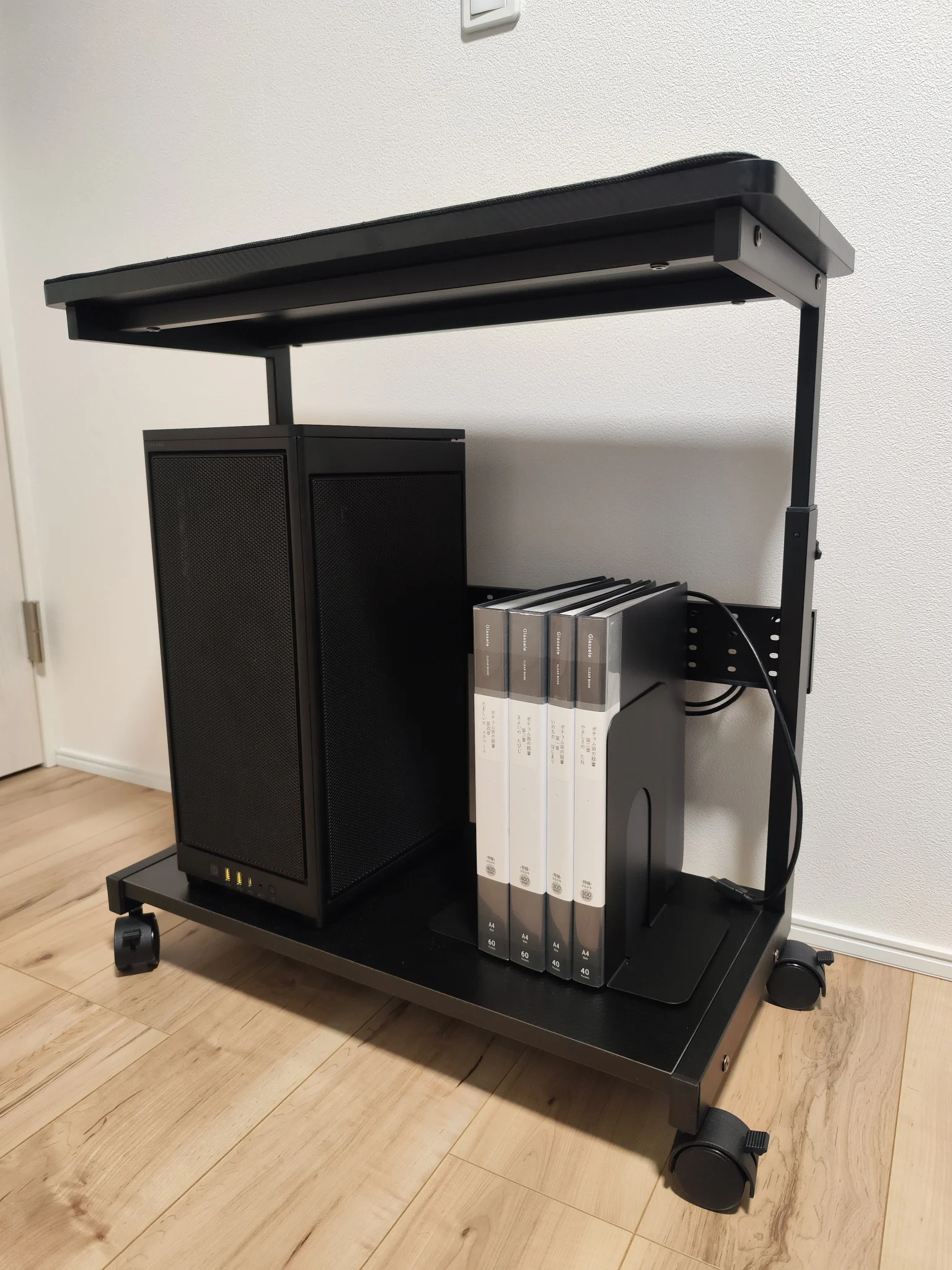 | 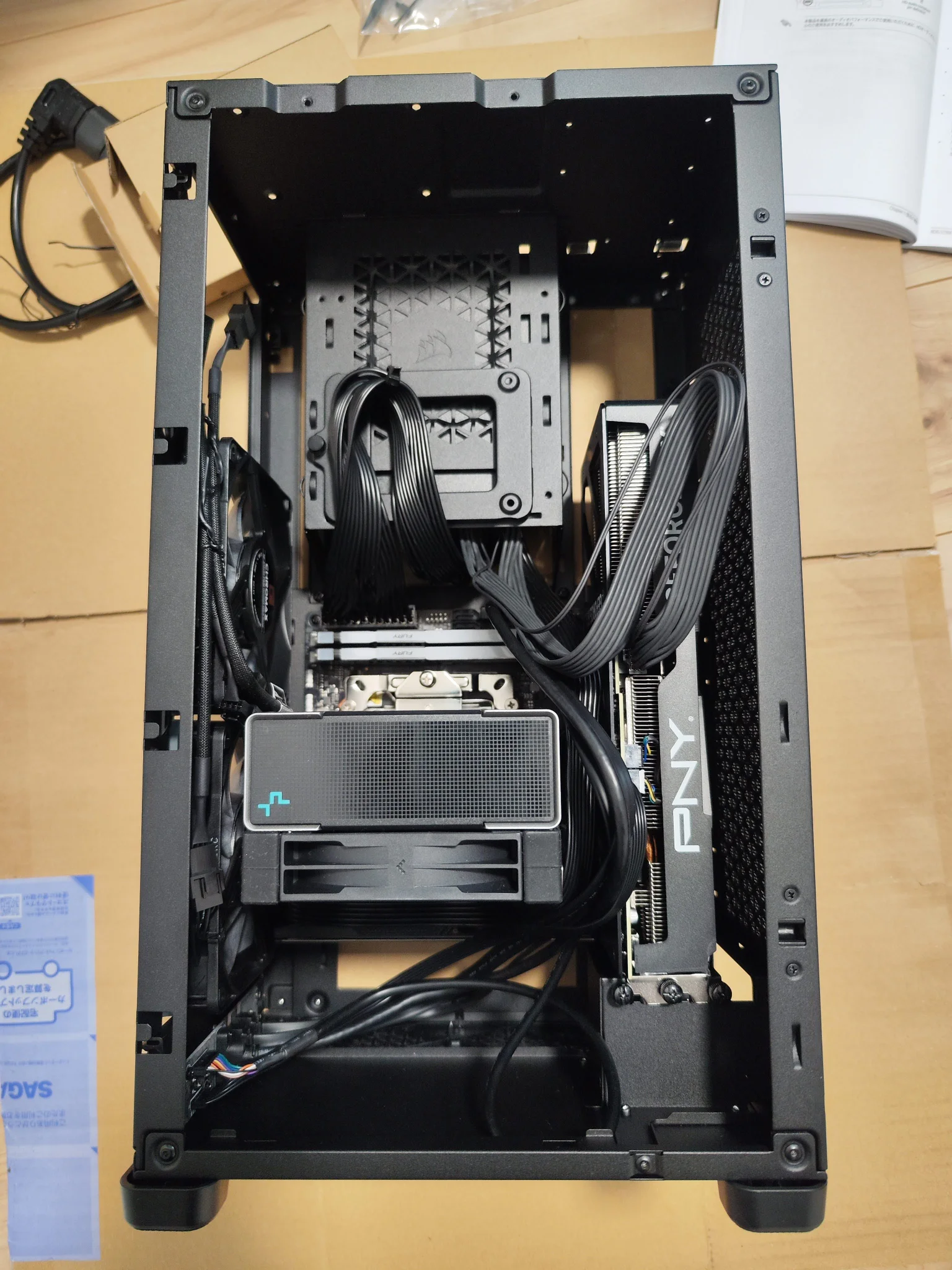 |
| Size comparison with A4 binders | Photo taken during assembly |
| Idle State (Task Manager) | Under Load (Stable Diffusion) |
|---|---|
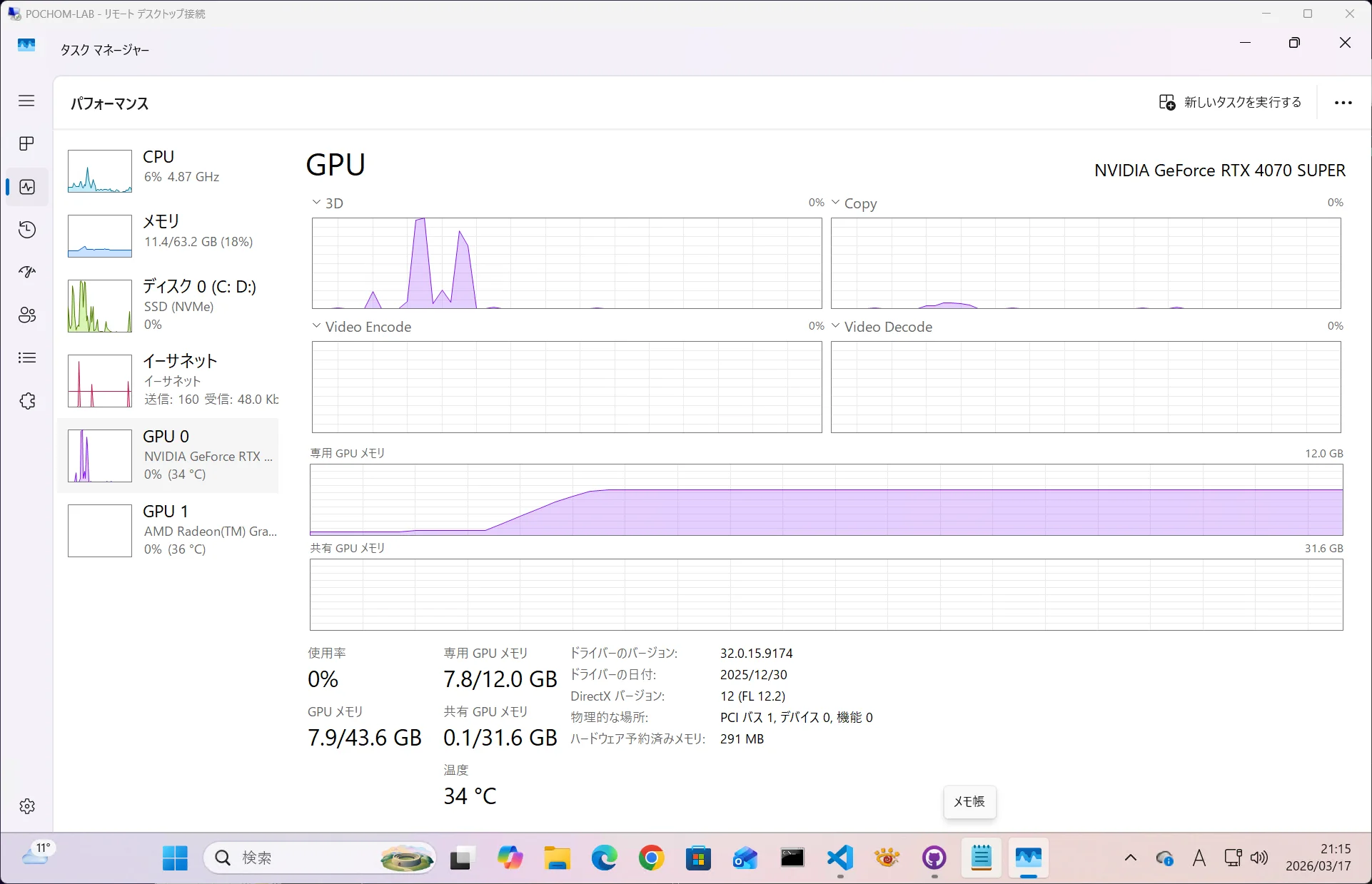 | 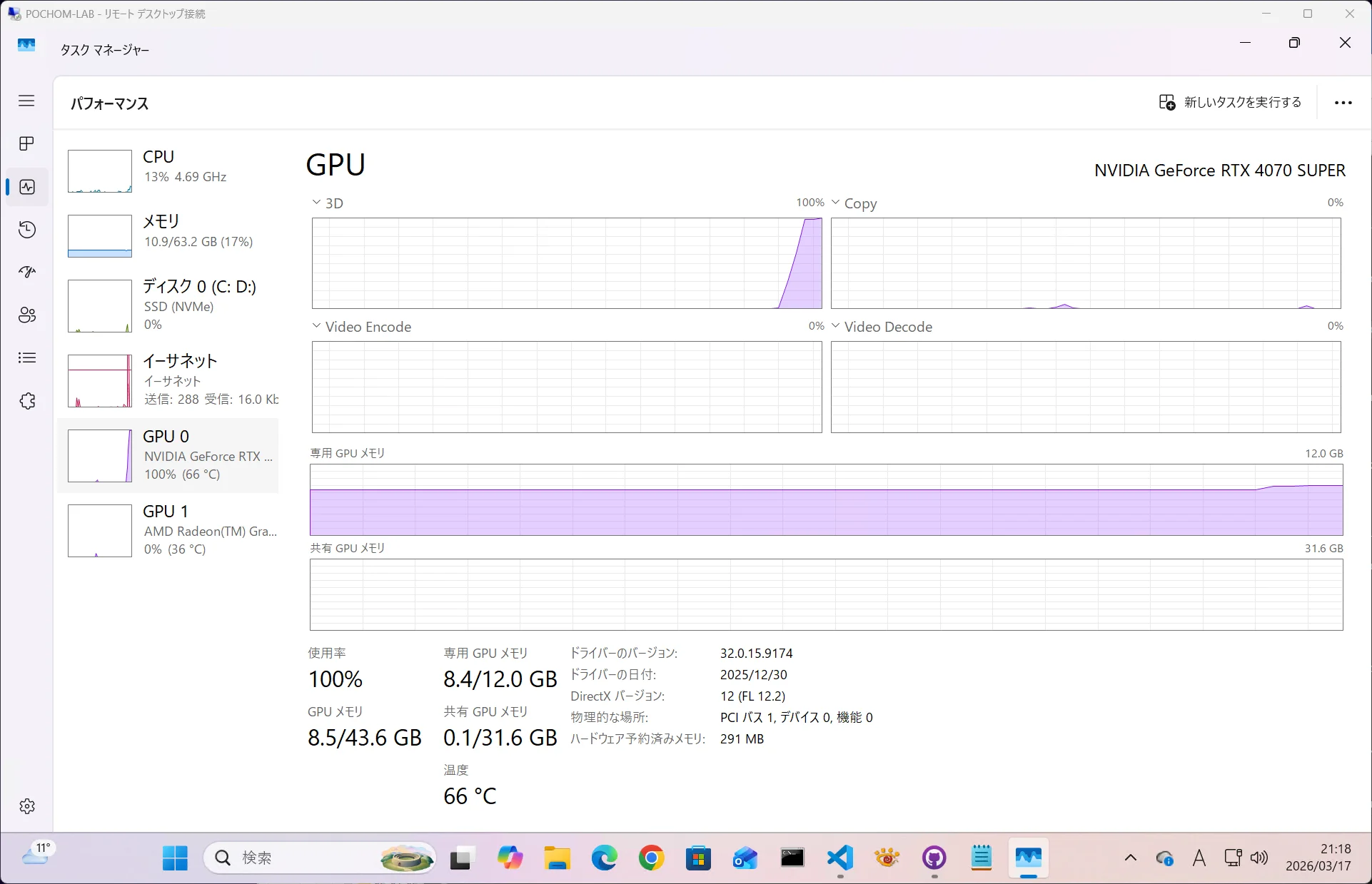 |
| GPU temperature ~34°C | During Stable Diffusion usage, rises to ~70°C |
3. GPU Selection
The most critical component.
Initially, an RTX 4080 (16GB VRAM) was considered. However, due to price and availability constraints, it was not a viable option.
Final choice:
- RTX 4070 SUPER (12GB)
For generative AI workloads:
- SDXL → Fully usable
- ControlNet → Usable with some limitations
- LoRA training → Works with parameter tuning
This resulted in a well-balanced and practical configuration.
4. Case (Mini ITX)
The system was designed with a compact Mini ITX form factor.
Key challenges:
- Heat management
- Maintainability
Final selection prioritized:
- Cooling performance
- Vertical airflow (“chimney” structure)
- Ease of assembly and maintenance
The result is a compact yet accessible internal layout.
5. CPU / Motherboard
- Ryzen 7 7800X3D
- ASUS ROG STRIX B650E-I
Having used AMD platforms for years, the choice was straightforward. This is the first time using a ROG motherboard.
6. Memory (64GB)
- 32GB × 2 = 64GB
Prices were already rising at the time of purchase, so the decision balanced performance and cost.
- EXPO II (6000MHz): not used
- EXPO I (5600MHz): stable operation
For generative AI workflows:
- LoRA training
- Batch generation
- Parallel workloads
64GB provides comfortable headroom.
7. SSD
Selected based on reliability and price-performance balance.
8. Power Supply (850W)
- CORSAIR SF850L
Reasons for selection:
- 850W provides sufficient headroom
- Fully modular for cable management
- Good compatibility with Mini ITX builds
In practice:
- No coil whine (even in winter conditions)
- Quiet operation
Stable under long workloads.
9. Cooling
- DEEPCOOL AK400
- Noctua fans ×3
Designed for long-running workloads such as LoRA training:
- Low noise
- High cooling performance
■ Results
- Stable long-term operation
- Successfully built a local Stable Diffusion environment
- No major issues during assembly
A practical and reliable generative AI workstation was achieved.
■ Notes
- GPU prices increased significantly after purchase
- Memory prices also surged
- Timing of the build was favorable
This domain is highly sensitive to market timing.
■ Postscript
This was my first self-built PC in over a decade, since the Phenom II X3 720 BE era.
Previously, I focused on budget-oriented builds, but this time prioritized stability.
The result:
- Smooth assembly
- Stable operation
A solid foundation for ongoing work in PochomLab.
■ Addendum (Price Situation as of 2026)
This system was originally built for approximately ¥300,000.
However, as of 2026, component prices have changed significantly:
- GPU (RTX 4070 SUPER): over ¥200,000
- Memory (64GB): approximately ¥160,000–¥180,000
Rebuilding an equivalent system today would likely cost around
¥550,000–¥580,000 in total.
PC component prices are highly influenced by market conditions,
highlighting how critical timing is when building a system.